Showing posts with label balance. Show all posts

Sunday, November 11, 2012

Quiet: Part 3, The Book

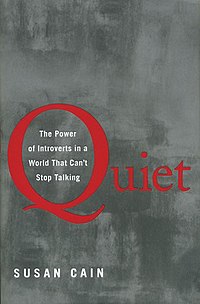
  In Part 1 and Part 2 of my discussion on this topic, I covered how the book (pictured at left) made me think about my experiences as an introvert, now I'm going to cover some of the details of the book itself and why it's worth reading.

What it has going for it:

    The book goes over the science of introverted and extroverted personality types. The author is not a scientist herself, but has done quite a bit of research into the science and spoken to scientists, psychologists, and other experts on the subject. Having these examples, studies, and case studies included is really helpful for people who have never really understood why they are more introverted or extroverted.
    It goes a long way to making a case for a new approach for rearranging education and workplace environments, as well as how we interact and communicate with our peers, partners, family members, coworkers, and others around us.
    It includes backgrounds and case studies on specific individuals in places like Harvard Business School and Silicon Valley, and explains how some introverts overcome some aspects of their personality in order to lead a cause, do a job, or participate in their relationships.
    Unsurprisingly, the book is sympathetic to introverts, but it is not entirely condemning of extroverts. Rather, it condemns the "extrovert ideal" and supports a more balanced or mixed standard. This standard will focus more on allowing each type of individual to demonstrate their strengths rather than expecting or even requiring individuals to show a particular set of skills or personality traits, and condemning them when they don't. It applies to teaching, parenting, hiring, working together, living together, and any aspect of our daily lives and interactions.

Author Susan Cain

Where it is lacking:

    Not enough case studies. The book is nothing but psychological experiments and case studies, but I still felt like it didn't go as deep as it could have or offer as many examples as it could have for some of the topics, especially during the second half of the book.
    I think the book would have benefited from talking about more successful, well-known introverts. It discussed a few, like Rosa Parks, Gandhi, Steve Wozniak, Eleanor Roosevelt, and Warren Buffett, but it could have included more examples, specifically more modern examples that include discussion with the person directly rather than taking details from biographies.

Why it's worth the read:

    If you're an introvert, you can learn more about why your brain works the way it does, why you prefer certain activities and habits over others, and a little bit about how, why, and when you should go out of your introverted comfort zone.
John Lennon
Peace Monument,
Liverpool, UK
    If you're an extrovert, you can learn more about some of the quiet people around you, and how not to take it personally when they don't agree with you or don't want to participate in an activity you suggest. You can learn more about how introverts "shine" and why you should give them the benefit of the doubt when it comes to social norms. 
    Overall, this is a great book for everyone to gain a better understanding of both personality types and how to get the most out of your interactions with each no matter what you're working on--a class project, a client report, a marriage or anything else.
Give peace [and quiet] a chance.
-John Lennon

Thursday, November 8, 2012

On Being Quiet: Part 2


  Western culture rewards extroverted behavior--assertive, overbearing at times, jovial, bubbly. When I was kid, everyone commented how smart I was and how great it was that I liked reading a book and drawing when I didn't have any other kids to play with. As I got older, I was pigeon-holed for being too shy, too quiet, and too antisocial. I still made friends. But I didn't have as many friends because I wasn't really shiny and bubbly. I didn't make the first move in the conversation. I didn't like to crack jokes or put myself on display so that others would see how funny I was. You don't get me until you get to know a little better.
    At work, being a person at the point of sale at the cash register and being the receptionist answering the phone and greeting people at the front desk, I also was criticized (albeit more politely and constructively) for being too quiet. Now I know, maybe I shouldn't be in a job where I have to answer the phone or greet people. It isn't that I'm unfriendly, I'm just shy about it.Yes, still. even when it's my job not to be, it's still difficult to pretend to be happy to see a customer or a client when it really doesn't make a difference to me personally if they are there or not. It's not like I worked on commission or like I knew them all really well.
    The last thing I am is phony, which is probably a big reason why I am not very good at small talk with strangers or greeting customers. I am focused on my other tasks and my own thoughts and projects, and having to put on this happy face feels false to me. Some people consider it just being friendly, but I draw a line between what I consider friendly and what I would consider going overboard with vivacity, for me anyway. I will smile and say hello, friendly enough for me, but I'm not going to strike up a conversation about your kids or the weather or the basketball game last night (overly vivacious).
    All this time, I've felt like there was something wrong with me because I wasn't bubbly and giggly and super-friendly and didn't like parties or participating in class or meetings when I didn't have anything constructive to add. Now I realize that there's nothing wrong with me for being that way. It's just how I'm wired, genetically and through my upbringing, and I don't see why I should be forced to be somebody that I'm not.
    I have other valuable traits and skills that are a result of my quietness and I think that people should take advantage of those things and reward and appreciate those parts of my abilities and my personality rather than trying to mold me into something I'm not. I'm not a dog--I'm not going to jump all over you and wag my tail and bark when you come into the room. I don't even do that with people I really care about and know well. I will be polite, but I can't promise anything more than that until we know each other better.
    As a child, I was painfully shy. I am not as shy now, but I will still avoid large groups of people and noise and anything that stresses me out physically. As a child, I was extremely sensitive to this things. I got sick in church once because I became so incredibly nauseatingly claustrophobic surrounded by so many people. I am still claustrophobic in crowds of people (paradoxically, many small spaces are quite comforting to me) and I will start hyperventilating if it gets really uncomfortable, but it occurs more at parties where I'm expected to interact rather than coming out of a movie theater in a massive throng or standing next to people at a concert. I don't know these people and no one is asking me to get to know them. But at a party or a "networking" event or some other social gathering that I'm expected to participate in, that's when the claustrophobia and anxiety sets in.
    While I can now stand up and give a presentation, in front of 5 people or 50, I can't do it off the cuff. I have to have time to prepare. Some of the problems I experienced throughout my education and other situations growing up is because I was expected to adhere to a standard that was set for extroverted people. I am terrible with the Socratic method (used too much in philosophy classrooms considering how many of us are introverts!) because I need more time to process and formulate my answer. I'm not stalling because I don't know it (not every time, at least)--I'm trying to put my thoughts into words and put those words together in a coherent manner. I simply cannot come up with something to say just because you point at me when my hand wasn't raised.
    It's also why I don't like arguing or debating. It's not that I don't have good opinions or interesting insights. I think a lot! I've got plenty! It's just that in an argument, particularly, even a friendly one, trying to follow the other person's line of thought while managing my own and trying to figure out when to respond to their point and when to propose mine is a lot of mental work--if you think about it, those who are able to do this easily are really amazing communicators! I can't formulate my ideas at the same time as I'm digesting the other person's. Which means I lose a lot of arguments. I don't "think on my feet" well. Many people like to assume they win an argument because they are able to speak more forcefully and confidently than their opponent, but this is not always the case. Confidence does not equal correctness. It just means they are better verbal communicators.
    This is why I also prefer writing to speaking. I can take my time to work on a problem or an argument or a topic and add the right details and evidence and background information. I can work at my own pace and I can go back and rework something if it's unclear or if I think of something to add.
    One thing I realized recently is that maybe I should not be looking for a position that requires me to answer phones or greet customers. I may be good at the other "introverted" parts of the position, working individually, organizing dates, projects, files, managing my time, but I am not as good at the "extroverted" aspects which require a more social aspect with strangers that makes me feel uncomfortable and like I am not being myself.
    Part 3 of this series will be focused on the book itself. Why people should read it, where it was really beneficial and where it was lacking. Still haven't decided if I'll do any additional commentary beyond that, but it's given me a lot to write about so far, so it's possible!
“Or at school you may have been prodded to "come out of your shell"- that noxious expression that fails to appreciate that some animals naturally carry shelter wherever they go, and that some humans are just the same.”

Monday, November 5, 2012

I'm Quiet and There's Nothing Wrong with That

  I feel like I should have a t-shirt that says: "No, I don't want to talk to you, and that doesn't mean there's something wrong with me." I have felt inadequate and uncomfortable throughout most of my life because of my quieter personality. It's not that I'm antisocial or that I don't enjoy other people's company; I'm just not interested in being around people ALL the time. After getting into this new book I've been reading, Quiet: The Power of Introverts in a World that Can't Stop Talking, I realize that there isn't anything wrong with me--there's just a disconnect with the way our culture views people like me.
    There are people who don't like (or at least, limit their interaction at) parties or large gatherings, don't like to speak up in a classroom full of people, prefer to study and read and spend time alone more often than not. These people are often introverts, and they are often dubbed antisocial or socially inept simply because large groups of people, loud noises, and speaking spontaneously or on the spot make them physically and psychologically uncomfortable.
    I'm not socially inept. I'm not antisocial either. I like people fine. I will talk your ear off, if you let me. I do like getting out and interacting with others. I can be loud and obnoxious. I just don't feel the need to do these things all the time.
    Once I get to know people, I am much better at talking to them. At a party, I am much more comfortable when I know the majority of people there than when I only know one or two people. Either way, I am apt to be a wallflower, but at least when I know most of the people, I can be pulled away from the wall and into the conversation.
    When it comes to conversing, I can speak intelligently about things. I can share my opinions pretty eloquently when given the chance. But I don't dominate the conversation or debate too heatedly because I am terrible at speaking spontaneously. I can't argue about something on the spur of the moment. I can't win a debate without due preparation. And I don't enjoy doing either because it happens too often that the person I'm debating is more forceful than I am and will look like the winner no matter how good my argument is simply because I do not carry the same weight in my presentation that they do. It's not that I don't know what I'm talking about. It's just that I have a lot more trouble explaining my ideas verbally in a convincing way than I would explaining them through writing.

    My entire life, people have been trying to "pull me out of my shell." I like my shell, thank you. It keeps obnoxious, loud people and things out. It also gives me a quiet place to retreat to when I need to process information or think about how something works or why something is. (This personality trait is probably the real reason I became a philosophy major. Philosophers are often quiet types prefer to think and reflect rather than talk, speechify, share and sell.)
    And you know what? There's nothing wrong with wanting be alone sometimes, wanting to think for a few minutes before I speak, or choosing to observe rather than participate. That's just the way some people are built to explore and experience the world. We will join the party, speak when we're ready, and participate when understand the game or conversation subject. We just need, and enjoy, a little more time to internalize the world than other people do. It's not a flaw. It's a fact, and it's an advantage in many ways.
    Being quiet and observant means it will often take us less time to understand how to do things. We learn from mistakes better and more quickly because we took the time to figure out what went wrong and how to avoid that outcome the next time. It means our arguments are often more structured and reasoned even if our enthusiasm and decibel of speech is not quite as high as someone else's. Those are good things to look for in a person, whether it's a friend, an employee, or a partner.
    This isn't to say that quiet types should try to take over the world and eliminate extroverted, social, talkative types. As always, moderation and balance are important with any two extremes. The point here is that, I'm quiet, and there's nothing wrong with that. Just because I don't act enthusiastic about everything or laugh at your jokes doesn't mean I'm deficient in some way. It just means I'm taking it all in. I experience the world like a game of chess rather than Marco Polo. I reason my way through it rather than feel my way blindly. We need both types of people throughout the world in business, family, and personal areas of our lives.
    I merely want to point out that you don't need to try to pull me out of my shell or try to get me to speak up. I'll come out on my own when I'm good and ready, and I'll speak when I've got something to say.
    This is part one of a series on this topic (I haven't decided how many posts to include in the series just yet). Next time, I'll delve into more examples of how being quiet has shaped my life, and how people have tried to unshape my quietness.
Those who know do not speak. Those who speak do not know.
-Lao Tzu

Wednesday, September 21, 2011

The Worst Kinds of People

  I read an article today about the worst kinds of coworkers to have, the loud mouth, the bad influence, the rival, the downer, etc., and it got me thinking about people I know who are like this. Not necessarily coworkers, as I have pretty awesome coworkers, but just people I've known or that I know now who are people I probably shouldn't know.
    As far as someone who talks too much, I'm probably guilty of that one. I don't blab other people's secrets. Not secrets. I do have a tendency to overshare my own thoughts, and sometimes, when it's really good news or really juicy gossip, I have a really hard time not sharing it. Sometimes it's just with my boyfriend, and he doesn't really count because he doesn't talk about anything I tell him to other people, but sometimes it's sharing with my coworkers, and I probably shouldn't share all the stuff I do with them. There are some things that, because we work together, probably should be kept to myself.
    Bad influences, I know a few of those people. The ones that tell you to skip class to go to the brewery, the ones that talk you into coming to that party you didn't want to go to because it was going to be nothing but a bunch of people you don't know drinking stuff you don't want to drink, the ones that convince you to hang out or go do things that you don't have the money to do just because it sounds like so much fun. I think we all have this bone in our bodies--we all do a little peer pressuring from time to time, whether it's something little or something big. The difference is that we aren't the pusher all the time. Some people are always going to dare you to do the thing you know you shouldn't be doing because they have a little danger streak that they want to share.
    Overly competitive people--I was in IB in high school. I didn't finish, but I knew my fair share of overly competitive people. The ones that will always ask what you got on your test and caw happily when they find out they got one point better. (I did enjoy doing better than other people, I just didn't say it out loud that I got the better grade or that I was proud of myself for having gotten it.) The people who will always turn in the paper a week early and stick their hand up first to get their answer in. The only person I think I've ever really competed with is myself. I'll admit, I am a little competitive at work. I want to get my good idea in first, and I want my creativity to shine over everyone else's when I get the chance to. But I'm not the most creative person there, and I don't have the experience with certain aspects of the job that other people do, which limits me in some respects, and it means that that chance to shine doesn't come around as often as it used to when I was in school, getting grades.
    The downer is that person that can always find something negative to say about whatever happens or whatever else is said. I have DEFINITELY known people like this. It's really unfortunate because they're usually decent people, they just have an overly pessimistic outlook on life and people and the world. I have days where everything sucks--I think you'd have to be an automaton if you didn't have days like that at least sometimes, however infrequent. But some people are just distrustful, angry, regretful, and unhappy people that live by the adage misery loves company. These are probably the worst ones on this list because they bring everyone else down too, whether they mean to or not.
    I guess the point here is that while we all may be a little bit like these personalities from time to time, the point is not to be any one of them ALL the time. And maybe to be more like a few other personalities some of the time too--the encourager, the shoulder to lean on, the back-up, the giver--to balance everything out. (Sidenote: Using the new Blogger Interface right now. It's clean, and I like the posting part, LOVE the posting part, but the dashboard is weird. Too clean, too few buttons. Hard to find what you want.)
Be ambitious but not a shark. 
Be realistic not pessimistic. 
Be honest but not tactless. 

What kind of person do YOU think is the worst? 
Or... are you secretly one of them?
Share in the comments. 

Etsy Addict: A Few of My Favorite Things